Background Info
Exercise - NNP MD Simulations of CO2@ZIF-8
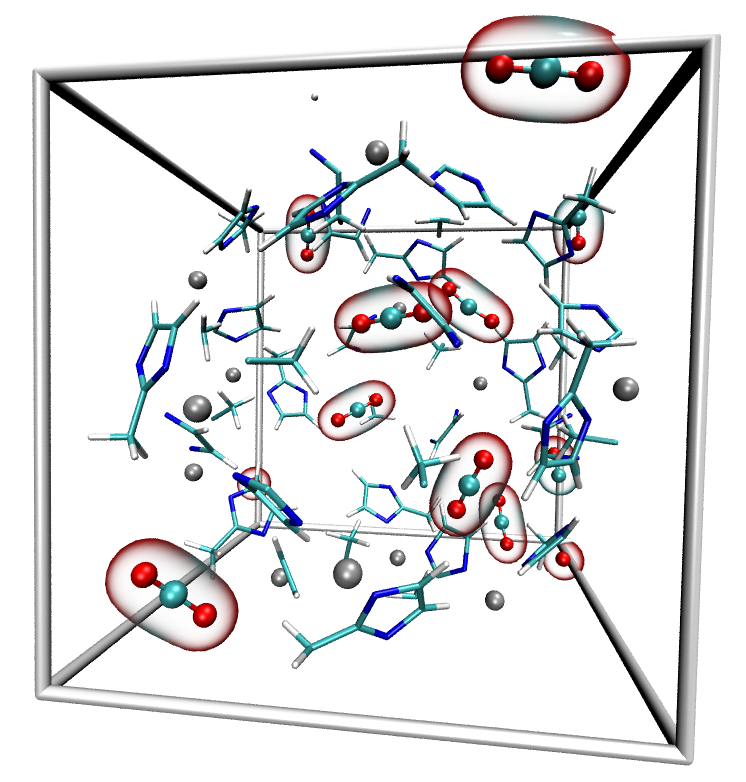 Metal-organic frameworks (MOFs) are hybrid crystalline materials assembled from both inorganic and organic residues containing potential voids [1]. The key advantage of MOFs over naturally occurring porous compounds such as zeolites (i.e. aluminosilicates) or polymers lies in their crystalline nature, which allows for systematic modification through crystal engineering principles by altering their organic linkers or metal nodes. This capability leads to an almost limitless number of possible framework topologies and properties, making them particularly appealing for technological applications. In 2025, the Nobel Prize in Chemistry was awarded to Profs. Susumu Kitagawa, Richard Robson and Omar M. Yaghi “for the developement of metal-organic frameworks”.
One of the most widely discussed applications is associated to the enormous gas storage capacity of MOF materials. Storage and separation of critical green house gases such as CO2 and CH4 are widely discussed [2,3]. In addition, due to their ultrahigh internal surface area, tunable pore dimensions, and rapid kinetics for gas adsorption and desorption, MOFs have emerged as highly promising candidates for capturing and storing carbon dioxide, called direct air capture (DAC) [4].
An increasing number of MOF compounds are discussed as potential host matrices for green house gases [4]. In this exercise, carbon dioxide storage in the comparably simple ZIF-8 (zeolitic imidazolate framework) is investigated via molecular dynamics simulations (MD), to keep the computational effort and memory demand manageable.
The ZIF-8 system Zn(2-methylimidazolate)2 crystallizes in the non-centrosymmetric cubic space group I43m (space group no. 217) with a lattice parameter of approx 1.7 nm. The cubic unit cell contains a total of 12 Zn2+ cations that are each tetrahedrally coordinated by four 2-methylimidazolate linkers. The pore structure of ZIF-8 is similar to the topology of a prototypic sodalite zeolite (hence the name zeolitic imidazolate framework). Several studies have investigated ZIF systems with respect to their CO2 storage capacity [5-8].
In order to achieve fast and accurate MD simulations, the MACE-MP neural network potential (NNP) [9-11] is applied, in particular the MACE-DAC-1 model [12], which is trained not only on solid-state systems but also on interactions with gases for direct air capture (DAC) applications. If trained properly, NNPs provide an efficient and versatile description of chemical systems, combining the accuracy of high level quantum chemical methods with the speed of classical force field approaches.
In this exercise the properties of the pristine host material (lattice parameter and thermal expansion coefficient) and the interaction between the inserted CO2 molecules and the ZIF-8 host (diffusion coefficient and activation energy of diffusion) will be studied.
[1] Yusuf, V. F.; Malek, N. I.; Kailasa, S. K. “Review on Organic Framework Classification, Synthetic Approaches, and Influencing Factors: Applications in Energy, Drug Delivery, and Wastewater Treatment.” ACS Omega 2022, 7, 44507 – 44531, DOI: 10.1021/acsomega.2c05310
[2] Li, B.; Wen, H.-M.; Zhou, W.; Chen, B. “Porous Metal–Organic Frameworks for Gas Storage and Separation: What, How, and Why?” J. Phys. Chem. Lett. 2014, 5, 3468 – 3479 DOI: 10.1021/jz501586e
[3] Li, H.; Li, L.; Lin, R.-B.; Zhou, W.; Zhang, Z.; Xiang, S.; Chen, B. “Porous metal-organic frameworks for gas storage and separation: Status and challenges” EnergyChem 2019, 1, 100006/1 – 100006/39 DOI: 10.1016/j.enchem.2019.100006
[4] Mahajan, S.; Lahtinen Ma. ”Recent progress in metal-organic frameworks (MOFs) for CO2 capture at different pressures” J. Environ. Chem. Eng. 2022, 10, 108930/1 – 108930/35 DOI: 10.1016/j.jece.2022.108930
[5] Abraha, Yuel W.; Tsai, C.-W.; Niemantsverdriet, J. W. H.; Langner E. H. G. ”Optimized CO2 Capture of the Zeolitic Imidazolate Framework ZIF-8 Modified by Solvent-Assisted Ligand Exchange” ACS Omega 2021, 6, 21850 – 21860 DOI: 10.1021/acsomega.1c01130
[6] Jiang, S.; Liu, J.; Guan J.; Du, X.; Chen, S.; Song, Y.; Huan, Y. ”Enhancing CO2 adsorption capacity of ZIF‑8 by synergetic effect of high pressure and temperature” Sci. Rep. 2023, 17584/1 – 17584/8 DOI: 10.1038/s41598-023-44960-4
[7] Kalauni, K.; Vedrtnam, A.; Wdowin, M.; Chaturvedi, S. “ZIF for CO2 Capture: Structure, Mechanism, Optimization, and Modeling” Processes 2022, 10, 2689/1 – 2689/32 DOI: 10.3390/pr10122689
[8] Heinz, K.; Rogge, S. M. J.; Kalytta-Mewes, A.; Volkmer, D.; Bunzen, H. “MOFs for long-term gas storage: exploiting kinetic trapping in ZIF-8 for on-demand and stimuli-controlled gas release” Inorg. Chem. Front. 2023, 10, 4763 – 4772 DOI: 10.1039/D3QI01007D
[9] Batatia, I.; Kovacs, D. P.; Simm, G.; Ortner, C.; Csanyi G. “MACE: Higher Order Equivariant Message Passing Neural Networks for Fast and Accurate Force Fields” arXiv, 2022, DOI: 10.48550/ARXIV.2206.07697
[10] Batatia, I. et al. “A foundation model for atomistic materials chemistry” arXiv, 2024, DOI: 10.48550/ARXIV.2401.00096
[11] ACEsuit/mace-mp https://github.com/ACEsuit/mace-mp (accessed 16. 10. 2024)
[12] Yunsung L., Hyunsoo P., Aron W., Jihan K. “Accelerating CO2 direct air capture screening for metal-organic frameworks with a transferable machine learning force field” Matter 2025, 8, 102203 DOI: 10.1016/j.matt.2025.102203